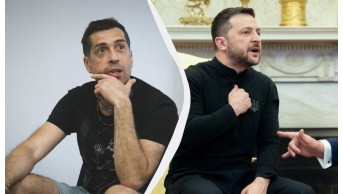
Max Pokrovsky's Bold Stand: US Mirrors Russia's Path?

In a world where the boundaries between politics and artistry often blur, Russian musician Max Pokrovsky finds himself at a striking intersection. Living in the United States for nearly a decade, Pokrovsky, the frontman of the band "Nogu Svelo!", has become an unexpected voice in the political arena. His recent comments on the clash between Ukrainian President Volodymyr Zelensky and former US President Donald Trump have stirred both intrigue and controversy.
A Musician's Unexpected Apology
Pokrovsky, who took to Instagram to share his thoughts, expressed a profound sense of disillusionment with his adopted homeland. He noted that the United States, once a beacon of democracy he sought, seems to be retracing the steps of Russia—a path he witnessed firsthand. "We moved to this country searching for justice, " he mused, comparing the current US political climate to Russia's past.
"Never did I think I'd be apologizing to Ukraine for America, " Pokrovsky lamented. "But here we are, on the opposite side of the 'beautiful ocean.'"
A Critique of Power
His words didn't stop at discontent; Pokrovsky took a bold step further by labeling Trump and US Vice President J.D. Vance as "scoundrels." His apology to Zelensky and the Ukrainian people felt like a personal mission, as he criticized the "dirty scene" in the Oval Office.
"As a US citizen, I apologize for the disgraceful display orchestrated by these two scoundrels, " he declared.
The Broader Implications
Pokrovsky's stance is more than a personal grievance. It reflects a broader narrative of international eyes watching the US's political theater. His transformation from a Russian rock musician to a vocal critic of global politics underscores a tension many feel—a longing for ideals that seem increasingly out of reach.
The situation also sheds light on the interconnectedness of today's global society, where actions in Washington echo in Kyiv, and voices from across the ocean resonate profoundly. As Pokrovsky continues to navigate this complex landscape, his journey remains a testament to the power of individual voices to challenge the status quo.
Editor: Yana Davydiuk